
Sinfonieorchester Basel – Franz Schubert – Symphony No.2 and No. 6
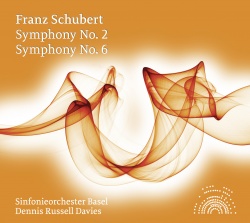
Artists: Sinfonieorchester Basel
Title: Franz Schubert – Symphony No.2 and No. 6
Catalogue No.: SOB 07
Release: 10.11.2014

Description
Schubert’s symphonies were designed for a ‘big audience’, but during his lifetime they were, at best, only performed in the semi-public rooms of the Seminary and those of the amateur orchestra. It was not until barely a month after his death that the first truly representative performance took place through the Society of Friends of Music (Gesellschaft der Musikfreunde) in Vienna. Leopold von Sonnleithner, a friend of Schubert’s, had some input into the programming and suggested the sixth symphony for the occasion. The “Great” C major could not be considered owing to practical constraints, but why was it number six in particular that was chosen out of his early symphonies? Were the reasons purely mundane – or was there a deeper rationale behind this decision? It would be good to know the answer, but today one can merely speculate.
The Sinfonieorchester Basel is one of the oldest and most important orchestras in Switzerland. It is strongly rooted in the north-west of Switzerland and at the same time enjoys a more than regional as well as international radiance. The Sinfonieorchester Basel is always again demonstrating anew its excellent quality, whether it be in its own concert tiers, in the Theater Basel or in guest concerts at home or abroad. Since 2009, the principal conductor has been the renowned American conductor and pianist, Dennis Russell Davies.
Tracklist
Largo – Allegro vivace
Andante
Menuetto. Allegro vivace
Presto vivace
Sinfonie Nr. 6 in C-Dur, D 589
Adagio – Allegro
Andante
Scherzo. Presto – Trio. Più lento
Allegro moderato

Max Müller – Weihnachten!
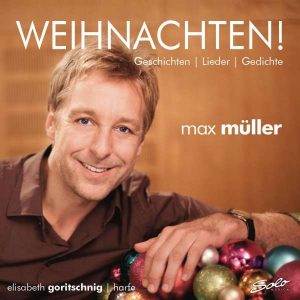 Max Müller
Weihnachten!
Katalog Nr.: 88875033532
Veröffentlichung: 31.10.2014

Produktbeschreibung
Jetzt legt der Künstler eine wunderbare CD mit Weihnachtsliedern in neun Sprachen und Weihnachtstexte aus drei Jahrhunderten vor.
Max Müller: „Ich bin in Kärnten aufgewachsen, wo man, theoretisch, die Möglichkeit hat, in drei Sprachen Weihnachten zu feiern: Deutsch, Slowenisch und Italienisch. Das hat wohl meine Neugier geweckt, herauszufinden, wie Weihnachten in anderen Ländern klingt und was andere Menschen in den letzten dreihundert Jahren zum Thema so geschrieben haben. Mittlerweile zähle ich viele Weihnachtsmusik-CDs mein Eigen – die Notenberge und Bücherstapel diesbezüglich habe ich noch nicht gezählt – und ich freue mich sehr, Sie mit dieser CD auf meine ganz persönliche Weihnachtsreise einladen zu dürfen. Begleitet werden wir dabei von der Harfenistin E. Goritschnig, der es tatsächlich gelingt, auch hartgesottene Weihnachtsgegner milde zu stimmen. Sogar im Hochsommer, zum Zeitpunkt der Aufnahme!Harald Krassnitzer im Vorwort zu dieser CD:……und jetzt kommst du, lieber MAX MÜLLER, und bringst mir dieses wunderbare Geschenk und machst all meine dumpfen Gefühle für Weihnachten vergessen. Führst mich mit deiner Musik quer durch Europa und weit darüber hinaus und erwärmst mein Herz mit den humorigen Geschichten von Jandl bis Rosegger und Storm bis Glattauer.
Ja, jetzt ist es mir wieder vollkommen bewusst. Der Heilige Abend ist eine ganz große Geburtstagsparty, und da geht’s gar nicht um die Geschenke und um die Gutscheine, sondern einfach nur darum, dass man zusammen mit vielen Menschen ein Fest feiert und das tut, was Sartre so wunderbar einmahnt: Lachen, einfach viel lachen und sich freuen. Ich danke dir dafür und wünsche dir auch eine fröhliche Weihnacht.
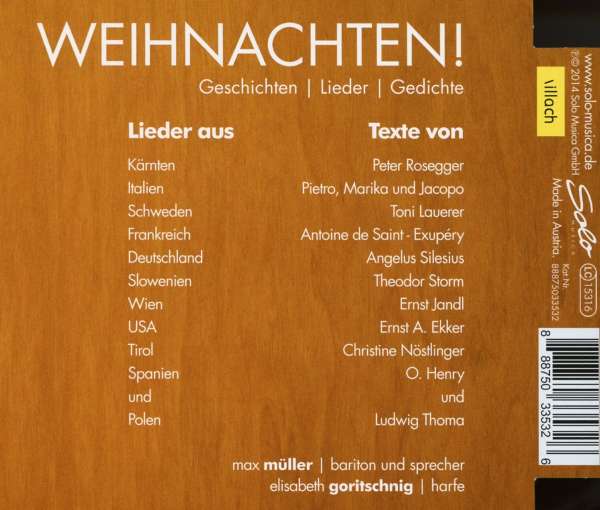
Backcover & Tracklist

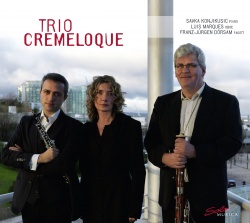
Trio Cremeloque – Trio Cremeloque
Description
Unlike Terzetto by Lalliet, Pavane pour une infante défunte (1899) by Maurice Ravel is a well known and much performed piece originally written for piano, and arranged by the composer for xxx orchestra in 1910. It gets a new timbre performed by Cremeloque Trio. In this version, the melody brought by oboe and bassoon gets on its meditative profoundness making it easy for the listener to evoke the atmosphere of the slow processional court dance of 16th and 17th centuries.
The Trio (1926) by Francis Poulenc was composed in Cannes and dedicated to Manuel de Falla. It is written in best French neoclassical tradition and probably is one of the most performed pieces within the repertory for this ensemble. Allusions to 18th century classicism is dense, the proliferation of classical themes is extended to the point when this Trio could be called not even neo-classical but hyper-classical music. What makes Cremeloque’s interpretation of Poulenc’s Trio different from the interpretation of other ensembles is – again – almost palpable corporeality of playing music to the point when enjoyment of performing bodies could be heard through every note.
Rachmaninoff‘s early Elegiac Trio in G minor (1892) comes as a kind of romantic and melancholic closure of this CD. This one-movement piece was originally written for piano, violin and cello. Cremeloque Trio opens the discussion about possibilities of re-arranging existing music for oboe-bassoon-piano formation particularly with this piece and makes the repertory for this not so common ensemble an open field of investigation. Looking forward to further results!
Tracklist
Works by:
Theodore Lalliet 1837-1892
Maurice Ravel 1875-1937*
Francis Poulenc 1900-1963
Sergei Rachmaninoff 1873-1943*
*Eigene Bearbeitungen
*Own adaptations

Anne Schmid / Giancarlo Pontiggia – Faszination Arkadien
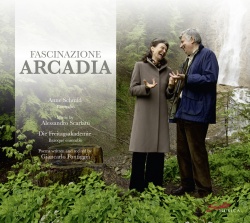 Artists: Anne Schmid, Die Freitagsakademie, Giancarlo Pontiggia
Title: Fascinazione Arcadia
Catalogue No.: SM 212
Release: 06.10.2014
Description
These metaphors touch on my own idyllic visions: I grew up near a gushing fountain; meadows, gardens, green lanes and flowers are the first things to indicate a closeness to nature and trigger a childish melancholy. When browsing through the works of Alessandro Scarlatti and composers of his period, I marvel at the range of cantatas which have been given a pastoral touch. Did the composers not grow tired of these ideas? While love stories certainly are attractive, Arcadia has promised something else that goes beyond the conventions adopted by composers at the time.
While studying in Venice in 2012 I happened to come across a complete original copy of Jacopo Sannazaro’s Arcadia, dating from 1504, in the Biblioteca Marciana. This 500-year-old little book would mark the start of my quest: day after day I visited the Marciana library; I read and absorbed the text until I could visualise, hear and smell Arcadia, while also gauging its immense significance in painting, literature, philosophy and music.
Just open a window and take a peek into the land envisioned by Virgil and depicted in verse by Sannazaro. This land has shaped a new perspective on humanity, a perspective which looks inwards rather than outwards. Arcadia is now experiencing a new heyday. I felt the need to give the theme plenty of poetic and musical freedom in order to present it in the right light. The poetry of Giancarlo Pontiggia draws on a variety of texts, ranging from the sources he has acquired from antiquity through to his rich language of today. Scarlatti, who was so inspired by Arcadia, now has the best of company in the 21st century!
Tracklist

Anastasia Voltchok – Goldberg Variations
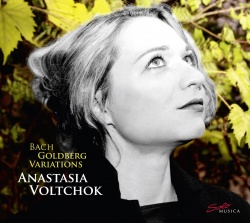
Artists: Anastasia Voltchok
Title: Goldberg Variations BWV 988
Catalogue No.: SM 209
Release: 06.10.2014
Description
Tracklist

Sinfonieorchester Basel – Igor Strawinsky – Le Sacre du printemps
Artists: Sinfonieorchester Basel
Title: Igor Strawinsky – Le Sacre du printemps
Catalogue No.: SOB 06
Release: 15.09.2014
Description
Version for Piano Four Hands performed by Dennis Russell Davies & Maki Namekawa
As early as spring 1910 Igor Stravinsky had a vision of a “great pagan festival” the climax of which would be the death of a young girl who dies of exhaustion after a frenzied dance, surrounded by the elders of her tribe. A further eighteen months would elapse however, during which Stravinsky consulted with the archaeologist and painter Nikolai Roerich to produce several versions of a libretto, before the composer set about realizing his vision by writing the score for this, his most famous ballet. Initially, the score bore the working title The great sacrifice, but was then renamed The Rite of Spring, and marked the international career breakthrough for the composer, not yet 32 years old, following his two earlier ballets for Sergei Diaghilev and his Ballets Russes, Firebird and Petrushka. And it has to be said that that breakthrough came with a mighty drumroll: when Le Sacre was premiered on May 29, 1913 at the Théâtre des Champs-Elysées, choreographed by the young Vaslav Nijinsky and under the musical direction of Pierre Monteux, the ballet caused one of the greatest scandals in the history of music and theatre ever – though it has to be said that Nijinsky’s choreography, with its stamping, twitching body movements that seem to truly mock the ideal of weightless grace normally expected in dance, was at least as much to blame as Stravinsky’s music. That said, this was not a performance suited to those of a nervous disposition, since the composer had transformed the orchestra to a great extent into a gasping, snorting, and above all hammering monster producing a sound that bore no resemblance whatsoever to the elegance of traditional ballet music.
Tracklist
1. L’Adoration de la terre 17:34
2. Le Sacrifice 18:28Le Sacre du printemps (piano version)
3. L’Adoration de la terre 17:29
4. Le Sacrifice 19:31

Markus Wagner – Suites for Violoncello Solo
Description
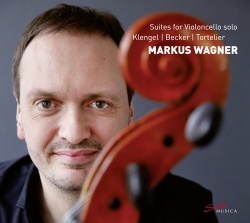
This CD presents the first recording of two original, very different and thus far unknown Romantic works for solo cello: Julius Klengel’s Suite in D minor op. 56 and Hugo Becker’s Fantastic Suite from the life of the woodland gnome op. 14. Both of these early twentieth century works represent the two leading cellists’ discovery of composing late in life. Like Paul Tortelier’s strongly Bach-oriented Suite in D minor, they are important additions to the cello repertoire. This year we celebrate with both composers anniversaries: Hugo Becker (150. year of birth) and Paul Tortelier (100. year of birth).
Markus Wagner has won prizes at several national and international competitions, including first prize at the Felix Mottl Competition in Munich in 1989, the Arts Bursary of the city of Augsburg in 1991, a medal at the Maria Canals Concours International de Musique in Barcelona in 1991 and a diploma at the Concours International d’Exécution musicale in Viña
del Mar, Chile in 1991.
In 1991 Markus Wagner became one of the youngest lecturers in Germany to be appointed to hold a cello major class at the Leopold Mozart Conservatory in Augsburg. After his appointment as professor in 2001, he moved to the Nürnberg College of Music in 2007.
Tracklist
Fantastische Suite Op.14 (1919)*
JULIUS KLENGEL
Suite d-minor Op. 56 for Violoncello solo (1923)*
PAUL TORTELIER
Suite en ré mineur (1946)*
*Weltersteinspielung

Rui Lopes & English Chamber Orchestra – Through Time
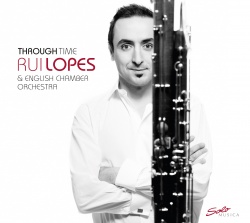
Title: Through Time
Catalogue No.: SM 211
Release: 07.07.2014
Description
The project was a great challenge, due to the difficulty of the pieces, but thanks to our amazing producer Andrew Keener we really had fun with it. I hope you’ll enjoy this journey “Through Time”.
Although Rui Lopes only began studying the bassoon at eighteen, his musical temperament and virtuosity were quickly recognized and received many awards, including first prize in the prestigious Estoril International Competition. One of the most promising bassoonists of his generation, he shares his great passion for music with concert audiences all over the world.
Tracklist
Divertissement für Fagott und Streichorchester – Jean Francaix*
Bassoon Concerto in B-Flat, KV191 – W.A. Mozart
Bassoon Concerto in C major, RV 472 – Antonio Vivaldi
Romance für Fagott und Orchester, Op. 62 – Edward Elgar**
*Weltersteinspielung in der Version für Streichorchester
** Weltersteinspielungfür Fagott und Streichorchester

Casal Quartett – Genesis 1757 – F. X. Richter
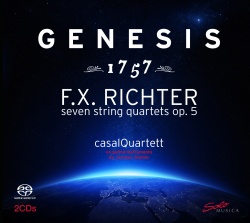
Artists: Casal Quartett
Title: Genesis 1757 – F. X. Richter – Sieben Streichquartette op. 5
Catalogue No.: SM 184 – 2 Hybrid SACDs
Release: 09.06.2014
Description
An ominous foreboding, blood in the snow, a corpse in winter …
These is the story of a tragic incident which took place near the court of the Duke of Hildburghausen in 1757, and forms part of the unusual credentials of a man who avoided a fatal end only by a hair’s breadth because he chose to play string quartets. In his memoirs, the violinist and composer Carl Ditters von Dittersdorf recalls refusing an invitation to take a ride in a horse-drawn sleigh due to a premonition. As a consequence, while Dittersdorf was playing first violin with his brothers in the court orchestra, a young man sitting next to the coachman on the sleigh ride was killed due to reckless driving. Stimulated with high-quality coffee and indulging in the finest tobacco, Dittersdorf named the celebrated composer of that era whose works they were playing that evening: Franz Xaver Richter, the Mannheim master of counterpoint and a composer of the most exquisite chamber music and symphonies.
Recent research by musicologists shows it is safe to assume that those works were very likely the seven quartets of opus 5, which are now to be released for the first time in a complete recording on the SOLO MUSICA label. Two exceptional CDs have been compiled, in cooperation with the SWR broadcasting company, featuring the casalQuartett from Zurich, an ensemble that won an ECHO Klassik award in 2010. As was the case on their previous two “BIRTH of the STRING QUARTET” CDs, this release features some almost unknown examples of stunningly beautiful string quartets played on four unique instruments by Jacobus Stainer, one of the most-sought-after European violin-makers of the 18th century. This release represents a milestone in the string literature, bringing to life works written 250 years ago, and it makes the case for a well-earned revival of one of the founding fathers of the string quartet.
Tracklist
Quartett g-Moll op. 5/5b
Quartett D-Dur op.5/6
Quartett A-Dur op. 5/3
Quartett Es-Dur op.5/4
Quartett B-Dur op. 5/2
Quartett G-Dur op.5/5

Duo Leonore – The 5 Sonatas for Piano and Cello – Beethoven
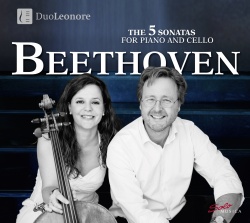
Artists: Duo Leonore
Title: The 5 Sonatas for Piano and Cello – Beethoven
Catalogue No.: SM 210 – 2 CD Set
Release: 26.05.2014
Description
Beethoven’s five cello sonatas are the quintessence of his personality and work: they exemplify creative development in an unparalleled manner.
We begin with the F major Sonata, marked by almost supernatural virtuosity in the typical spirit of Viennese Classicism. Our programme proceeds with the profound and powerful G minor Sonata, the A major Sonata with its much more lyrical subject matter, the C major Sonata with its concentrated musical material and vision of the future, and finally confronts the vast dimensions of the D major Sonata, with its magical slow movement and the final movement in the form of a wild fugue whose uncompromising ending might be the answer to the proposal in the F major Sonata.
We, Maja Weber, cello, and Per Lundberg, piano, have been playing chamber music together for more than twenty years, mostly in piano quartets and quintets. The idea of forming a duo was a natural consequence of our work together, and it was together that we chose the name “Duo Leonore”. We have always shared a strong need for artistic expression – and that, like many other things in our society, is something that has hardly changed since Beethoven’s time. We find our mutual musical passion reflected most especially in his music. That is perhaps because of Beethoven’s uncompromising belief in the power of music. Leonore, the heroine of his opera Fidelio, symbolizes Beethoven’s aesthetics for us: her humanism, personal readiness to make sacrifices and courage ultimately lead to triumph.
Tracklist
Sonata No.2 in g Minor Op. 5, No.2
Sonata No.3 in A Major Op. 69
Sonata No.4 in C Major Op. 102,No.1
Sonata No.5 in D Major Op. 102,No.2